Signals Music Studio
  • Courses & Books
    • Theory and Songwriting
    • Chord Progression Codex
      • Physical/Digital Bundle
      • Digital Edition w/ E-book
      • Physical Book
    • Real Rhythm Guitar: Level 1
    • 5-Day Blues Crash Course (FREE)
    • Master Barre Chords
    • All Courses
  • Posters
  • Login
  • Contact
  • Cart
  • Links
  • Affiliates
  • Videos
  • ···
      • Facebook
      • Twitter
      • YouTube
      • Instagram
    Signals Music Studio
    • Courses & Books
      • Theory and Songwriting
      • Chord Progression Codex
        • Physical/Digital Bundle
        • Digital Edition w/ E-book
        • Physical Book
      • Real Rhythm Guitar: Level 1
      • 5-Day Blues Crash Course (FREE)
      • Master Barre Chords
      • All Courses
    • Posters
    • Login
    • Contact
    • Cart
    • Links
    • Affiliates
    • Videos
    • ···
        • Facebook
        • Twitter
        • YouTube
        • Instagram
      Signals Music Studio
      • Courses & Books
        • Theory and Songwriting
        • Chord Progression Codex
          • Physical/Digital Bundle
          • Digital Edition w/ E-book
          • Physical Book
        • Real Rhythm Guitar: Level 1
        • 5-Day Blues Crash Course (FREE)
        • Master Barre Chords
        • All Courses
      • Posters
      • Login
      • Contact
      • Cart
      • Links
      • Affiliates
      • Videos
      How To Unlock Complex Rhythms And Groove In 7 Steps
      Next 7 Ways Musicians ACTUALLY Use Modes
      Free Online Guitar Lessons, Rhythm Studies

      How To Unlock Complex Rhythms And Groove In 7 Steps

      August 1, 2025
      6 min read

      Progressive rock, jazz, and fusion bands all feature complex grooves as part of their identity. If you’re not a drummer, it can be hard to find exercises that train these skills. This lesson will walk you through 7 steps to improve your sense of rhythm and timing. Along the way, you’ll find yourself encountering the deep complexities of polymeter, polyrhythm, and the versatile 12/8 time signature. These are all important skills to master if you want to eventually perform metric modulations accurately.

      We’ll be practicing these exercises with our hands, voice, and guitar. If you play keys, consider replacing the “foot tap” in each of these drills with a left-hand bass note, while the remaining rhythms can be played higher up with the right hand (as either chords or arpeggios).

      You don’t need a metronome for this lesson right away. Practicing to a metronome is great, but it can be impossible if your body and brain don’t fully understand what you’re trying to play. A better option is to first synchronize your entire self to your instrument and your voice – then take those skills and try to sync them up to a metronome.



      Step 1: Feeling 6/8 vs 3/4

      Play 6 steady notes on the guitar – I recommend an open but palm muted E string.

      Tap your foot every 3 notes and count out loud “1 2 3 1 2 3.” After doing that four times, start tapping your foot every two notes and count “1 2 1 2 1 2.” Do this four times and then switch back.

      Here’s what that looks like on guitar tab and a music staff. Notice in the first measure how the notes are beamed together, into threes. Compare this to the second measure, where the notes are beamed into pairs. You’ll often see notes get beamed in different ways depending on what the underlying pulse is.
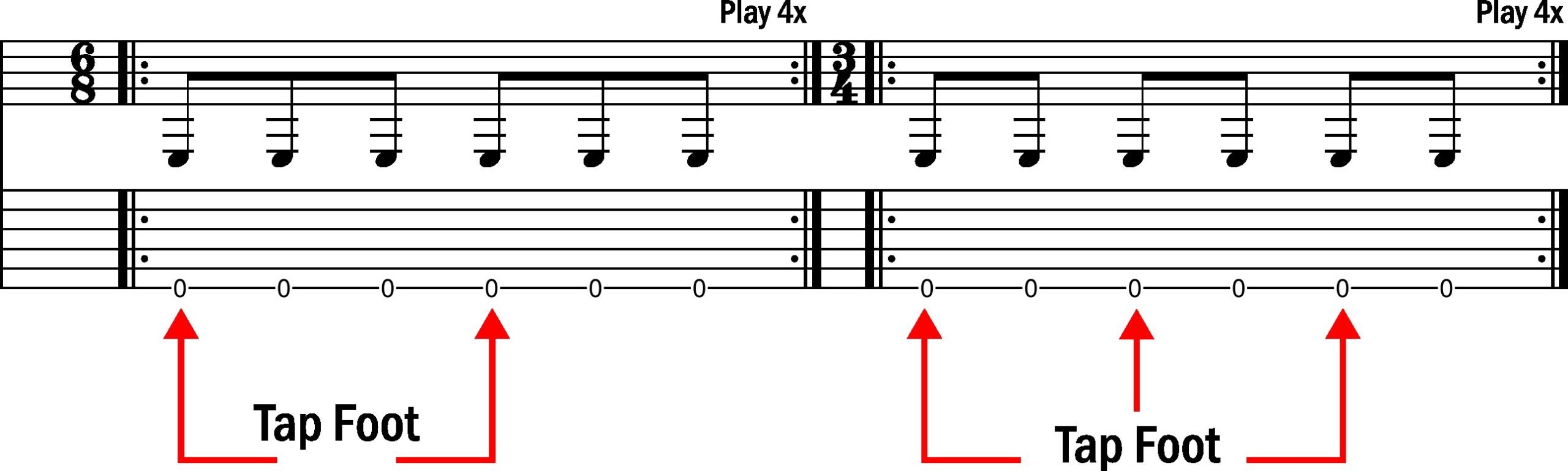
      What you’re experiencing here is the difference between the most simple examples of 6/8 and 3/4 time signature. They both hold the same amount of beats, but 6/8 is usually grouped as two groupings of three, whereas 3/4 is usually grouped as three groupings of two.

      Step 2: Groups of Three in 6/8 and 3/4

      Here’s a six-note pattern that is clearly grouped into threes. We’ll practice this while switching our foot taps like we just learned. Pay close attention to how the same exact pattern feels different when the underlying pulse of your foot tap changes.

      We’ll also practice this groove by counting out loud and clapping our hands. Try counting “1-2-3-1-2-3″ while clapping your hands on the 1s. Then keep your counting the same, but clap every two like this:

      “1 – 2 – 3 – 1 – 2 – 3″

      Step 3: Groups of Two in 6/8 and 3/4

      Here’s a six-note pattern that is clearly grouped into twos. We’ll practice this while switching our foot taps like we just learned.
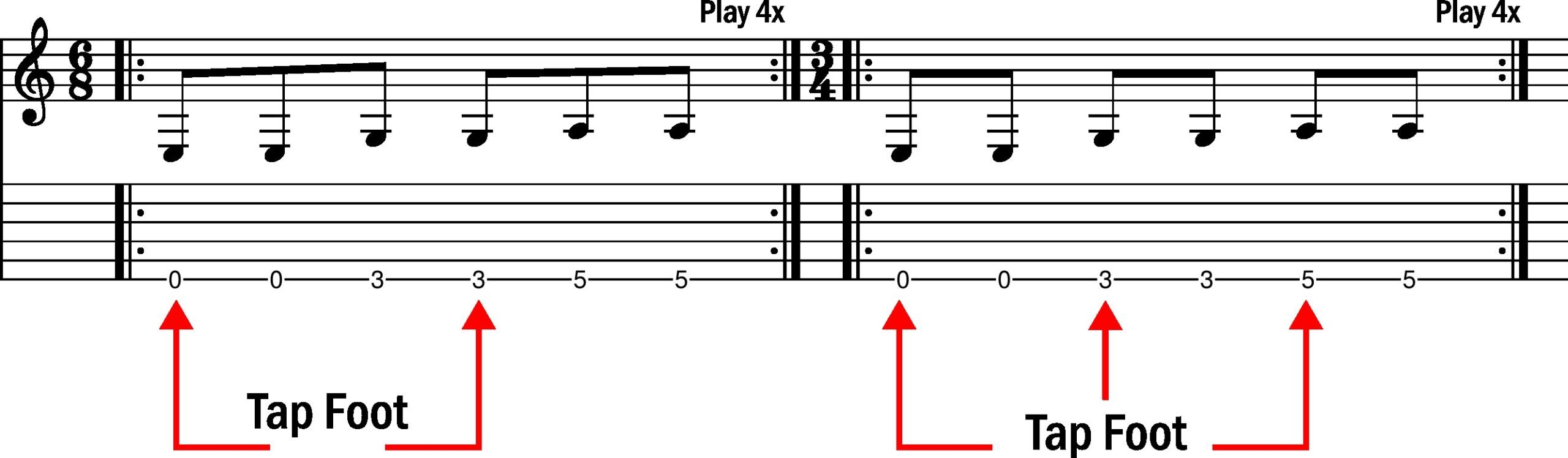
      Now try counting “1 – 2 – 1 – 2 – 1 – 2″ and clap your hands on every “1”. Switch to clapping every third note like this:

      “1 – 2 – 1 – 2 – 1 – 2″

      Step 4: Feeling 3/4 vs 12/8

      Let’s play a string of 12 steady notes on a palm muted note, but tap our foot on every third note while counting “1 2 3 1 2 3 1 2 3 1 2 3”.

      Once that’s comfortable, try switching so that foot taps every four notes, and count “1 2 3 4 1 2 3 4 1 2 3 4”.
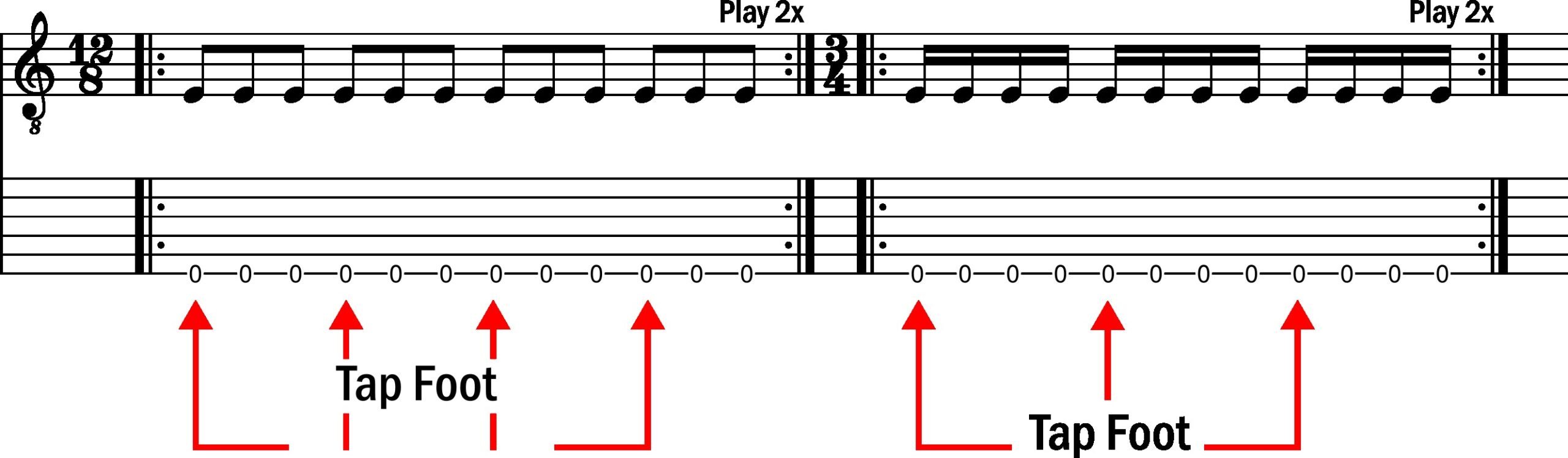
      Step 5: Groupings of Three In 12/8 and 3/4

      This riff has clear groupings of three. We’ll experiment with feeling it both ways – with our foot tapping every three notes, and also every four.
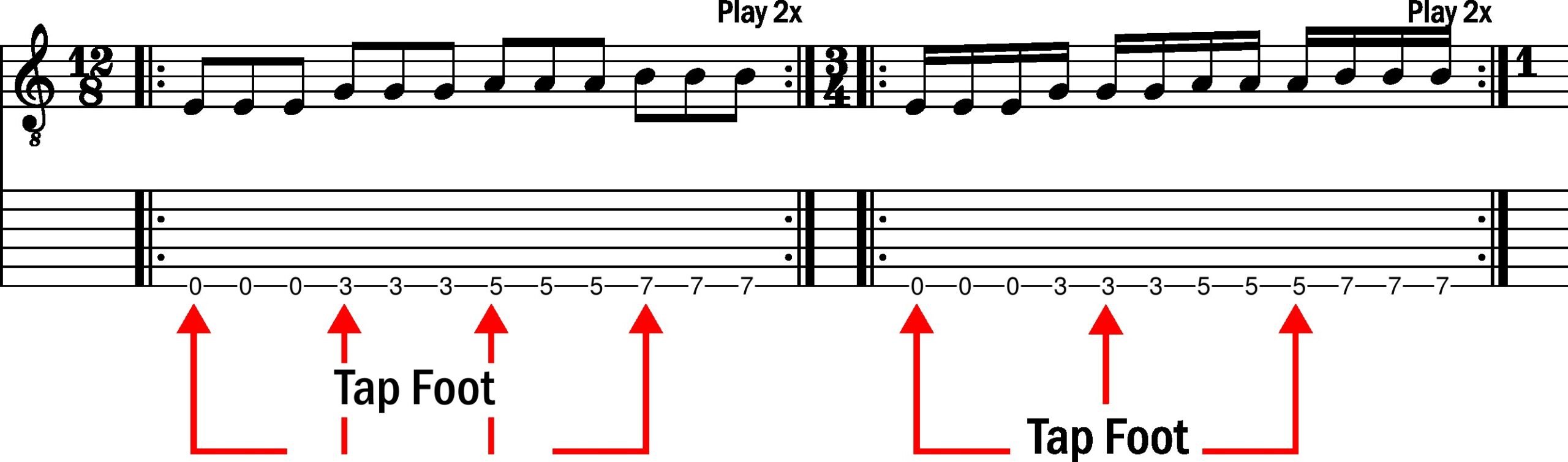
      Count out loud “1 – 2 – 3 – 1 – 2 – 3 – 1 – 2 – 3 – 1 – 2 – 3″ while clapping on every “1”. Then switch to clapping every 4th note like this:

      “1 – 2 – 3 – 1 – 2 – 3 – 1 – 2 – 3 – 1 – 2 – 3″

      Step 6: Groupings of Four in 12/8 and 3/4

      This pattern is grouped into fours. Again – tap your foot every three notes, then switch to every four notes.
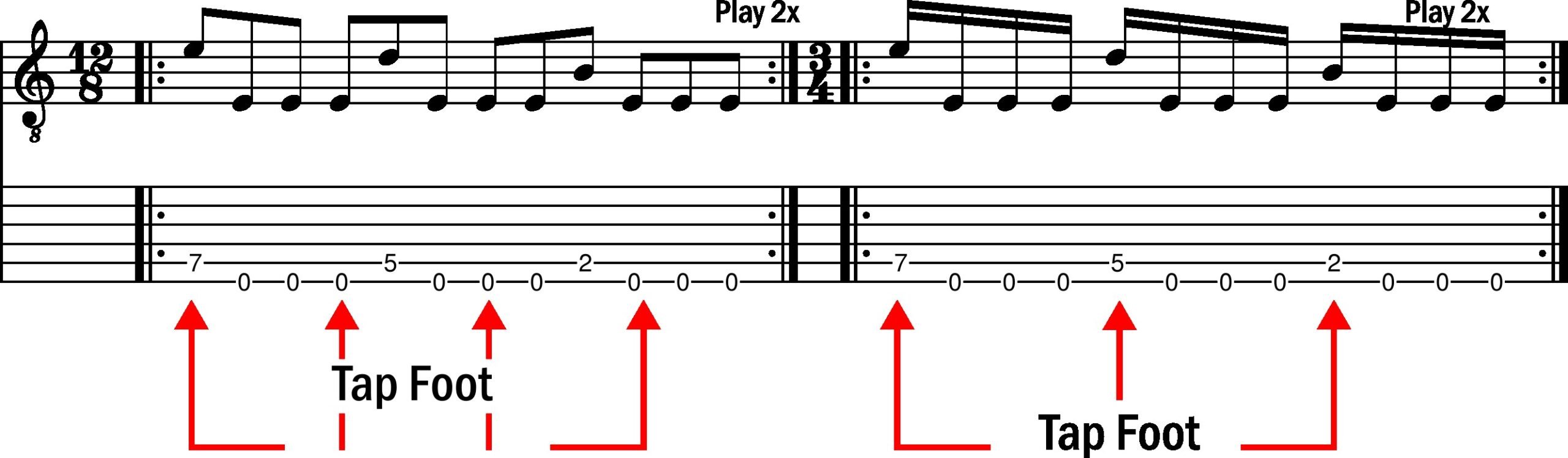
      Count out loud “1 – 2 – 3 – 4 – 1 – 2 – 3 – 4 – 1 – 2 – 3 – 4″ while clapping every 1. Then switch to clapping every third note, like this:

      “1 – 2 – 3 – 4 – 1 – 2 – 3 – 4 – 1 – 2 – 3 – 4″

      What Are We Even Doing?!

      What we’re now experiencing is the dualistic world of the 12/8 time signature. It is a versatile framework that can easily accommodate an underlying 3-pulse or a 4-pulse. In some cases, it will even demonstrate both.

      Being able to shift from one of these grooves to the other is an important skill if you want to master metric modulation, an advanced rhythmic technique. By keeping a pattern the same but speeding up the underlying pulse, we can change tempos in our song relative to the initial pulse.

      Step 7: Add Rhythmic Interest

      In all of these examples, we used steady notes for our patterns. Let’s take the same concepts and simply adjust our overall rhythms a bit to make them more interesting.

      For example, here is a grouping of four, but the fourth note is rested.
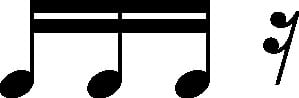
      Let’s play this pattern three times to produce a riff that is 12 notes long. Then we’ll experiment with tapping our foot on the 3s versus the 4s.
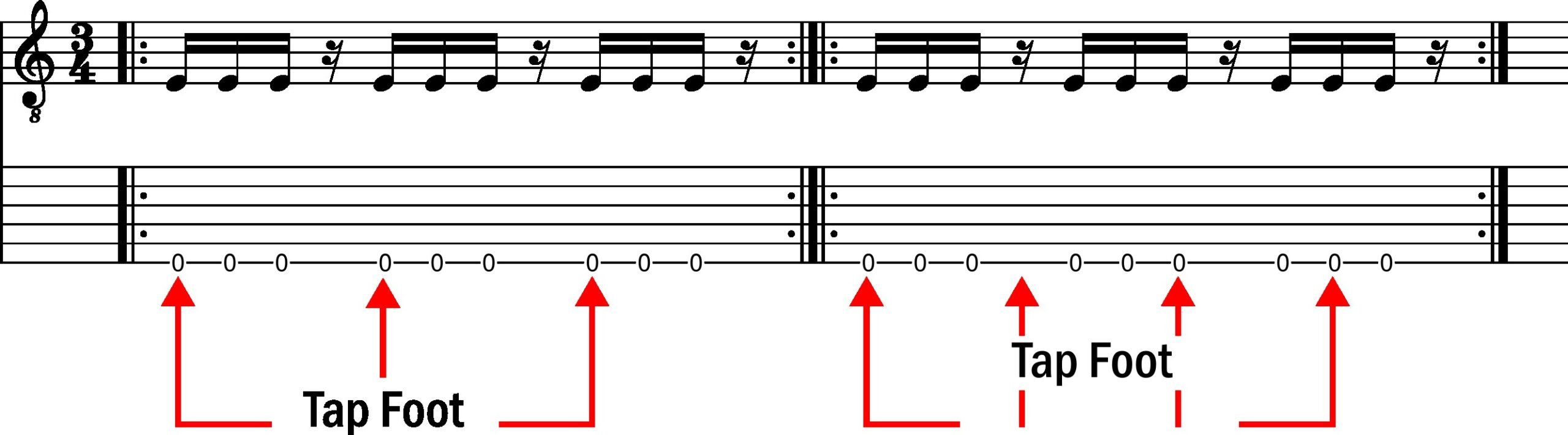
      That exact groove is what you’ll hear during the opening moments of “The Mirror” by Dream Theater. Later, another transformation of the same rhythm is performed. It could be written in 12/8, but I’ve opted for the 3/4 time signature instead.

      The Next Steps

      If you’re looking to expand your rhythmic skills, I can suggest the following videos and lessons I’ve made. They should compliment this lesson well.

      Polymeter

      Polymeter (lesson here) is when two different voices or instruments play at the same tempo, but in different metric cycles. For example: your guitar is playing a pattern of 3 quarter notes but your drummer is playing a pattern of 4.

      That’s what we’ve been doing in this lesson! Except in lieu of a drummer, we’ve been using a foot.

      Truncated Polymeter

      A more “digestable” approach to playing complicated polymeter, demonstrated here.

      Polyrhythm

      If you have mastered polymeter, then polyrhythms will surely follow. These naturally occur when you remove everything but the first note of each polymetric voice. My guide on the topic can be clicking here.

      Indian Konnakol

      Indian music contains the richest rhythm structures in all the world. This video showcases a “simple” exercise that for Indian music students is considered fundamental, but for most Western musicians will prove a nightmare.

      If you liked this lesson and want to improve your rhythm skills on guitar, check out my course Real Rhythm Guitar: Level 1.


      Jake Lizzio

      I teach music theory and songwriting for a modern generation of musicians who want to grow and excel at their craft.

      View all posts

      You may also like

      Free Online Guitar Lessons, Modes and Music Theory, Song Writing Lessons

      7 Ways Musicians ACTUALLY Use Modes

      5 min read
      Free Online Guitar Lessons, Song Writing Lessons

      How Voice Leading Creates Better Sounding Chord Progressions

      7 min read
      Rhythm Studies

      Why is the 9/8 time signature so confusing?

      5 min read

      Music Theory and Songwriting Course FAQs

      I’m not a guitarist. Should I still take this course?

      Probably! Only about 15% of this course is dedicated to the guitar, while the remaining concepts are taught in a way that can easily be applied to any other instrument. However, since all the theory taught is viewed through the lens of the guitar, it is HIGHLY RECOMMENDED that you own a guitar before pursuing this course to finish.

      I am a beginner/advanced guitar player but don’t know theory- is this course for me?

      This is not a course on guitar playing or technique, but on theory and songwriting. The only skills you are expected to know is how to read guitar tablature, and the absolute basics of guitar playing (how to fret a note, open chords, etc)

      How does your course compare to taking private lessons?

      I can confidently say that this method of learning will be more effective and valuable for many types of students. Since there is no wasted time or filler, it is more time-efficient than real life lessons where the teacher or student can get distracted. The printable materials are of a higher quality than most private lessons. And the ability to replay a lesson over and over is invaluable for students struggling to understand difficult topics.

      I watch your Signals Music Studio YouTube channel a lot, can these same topics be found for free on your channel?

      Not quite- my YouTube channel explores more advanced topics without explaining the prerequisites. 95% of the content in this course is totally unique and unexplored on my channel, and is taught in a linear fashion as to make sure you’re totally competent by the end. There are only two lessons that include cross over with my YouTube channel. However, after some lessons, Design and Develop by Inbox Technologyyou are directed to specific YouTube videos I’ve produced to help expand on your understanding of the previous topics and to help weave my channel in with the course.

      Does my access to the course expire?

      Nope! Once purchased you’ll have access for life, including any additional lessons or worksheets that get added in over time.

      Can I access the course offline?

      Currently, no. But I am working on getting a physical version of the course made instead of digital-only. Stay tuned!

      Are there refunds?

      If you are not satisfied with the course content or accessibility, you may request a refund within 30 days of purchase.

      Last time I looked, the price was $200 but now it’s $270. What gives?

      The sale price of $200 will only be available during special holiday promotions. Sign up to my email list to know when the next sale begins.

      There’s no way I can afford your course. But I really want/need it. Can you help?

      Reach out to me directly on my email and let me know your situation, I might be able to help =)
      Signals Music Studio

      Helping people write more music! Lessons and videos on music theory, scales, modes, chords, songwriting techniques, and song analysis with a focus on guitar.

      • Privacy Policy
      • Terms and Conditions
      • Join Our Affiliate Program
      • facebook
      • twitter
      • youtube
      • instagram

      Recent Lessons

      • How To Unlock Complex Rhythms And Groove In 7 Steps
      • 7 Ways Musicians ACTUALLY Use Modes
      • How Voice Leading Creates Better Sounding Chord Progressions

      Song Analysis

      • Analyzing the Chords from George Harrison’s “Something” – Perfect Progressions #2
      • Analyzing the Perfect Chords from “When I Was Your Man” by Bruno Mars
      • Analyzing the Perfect Chords from “We Are The Champions” by Queen

      Copyright © 2025. Signals Music Studio

      Home|Affiliate Program